Our name changed. Our mission continues.
illustration of a bullhorn

  MGH Institute of Health Professions is now Mass General Brigham University of Health Professions. Learn more.


The Working Families Tax Cut Act (Formerly the One Big Beautiful Bill Act)

The Working Families Tax Cut Act (Formerly the One Big Beautiful Bill Act) introduced significant changes to federal aid programs scheduled to go into effect July 1, 2026, for students applying for federal aid with the 2026-2027 FAFSA and beyond. 

The information on this page is provided by the Mass General Brigham University Financial Aid Office to offer timely guidance and help students understand recent changes to loans. We will update this page as new information becomes available. For official guidance, students should refer to studentaid.gov. You can also reach out to the Financial Aid Office for any questions.
Grad PLUS Loans

  • Phased out for new borrowers as of July 1, 2026: New Grad PLUS loans will not be available for new borrowers after this date.
  • Grad PLUS Loans for Existing Borrowers: Students who borrow any Direct loan or Grad PLUS loan and have it disbursed before July 1, 2026, remain eligible for Grad PLUS loans for up to three years or until their published program length, whichever comes sooner. There can be no lapses in enrollment during this period during any semester.

Graduate Unsubsidized Direct Loans

  • Limits for new borrowers as of July 1, 2026: Up to $20,500 per two-semester loan period; $100,000 lifetime borrowing limit.
  • Limits for Existing Borrowers: Up to $20,500 per two-semester loan period; $138,500 lifetime borrowing limit.

Undergraduate Direct and Parent PLUS Loans

  • Undergraduate Direct Loans: No changes but borrowed amounts will now count toward new lifetime limits.
  • Parent PLUS Loans for New Borrowers: Starting July 1, 2026, loans are capped at $20,000 per student per year, with a $65,000 lifetime limit per dependent student.
  • Parent PLUS Loans for Existing Borrowers: Students who borrow any Direct loan or whose parent has borrowed a Parent PLUS loan that has disbursed before July 1, 2026, can access these loans under current limits until completing their current degree, or for up to three additional years (whichever comes first). The current limits are up to the Cost of Attendance minus any financial aid.

Federal Loan Changes for All

  • New lifetime maximum of $257,500 for all federal student loans combined, excluding Parent PLUS Loans.
  • Loan proration for students less than full-time on all federal student loans due to the Schedule of Reductions (SOR). 
  • New federal loan repayment plans that will limit new borrowers as of July 1, 2026, to the standard repayment plan and repayment assistance program (RAP).

What is the Schedule of Reductions (SOR)?

The Schedule of Reductions (SOR) is a new federal requirement for all federal student loans starting July 1, 2026. Under SOR, the amount of loan funding a student can receive is directly tied to their enrollment status. Full-time students receive the full annual loan amount, while students enrolled less than full-time have their loan eligibility proportionally reduced based on the number of credits in which they are enrolled. Less than half-time students are not eligible for any federal student loans.

The Schedule of Reduction (SOR) rule applies to undergraduate, graduate, and professional students borrowing Federal Loans. Students who qualify as legacy borrowers for any federal loan programs will still be subject to the SOR calculation if enrolled less than full-time despite their legacy status.

Students should check their enrollment status each semester to understand how SOR affects their loan status and should contact the Financial Aid Office before making any changes to their enrollment status to discuss the potential impacts to their financial aid eligibility. 

*An important note: The SOR calculation applies to student borrowing, so the Federal Parent Plus Loan is not subject to SOR reductions for less than full-time study.
 

Graduate Credit Enrollment

  • Fall & Spring Semesters:
    • Full-Time: 9+ credits
    • Three-Quarter Time: 6.75-8.75 credits
    • Half-Time: 4.5-6.5 credits
    • Less Than Half-Time: Below 4.5 credits
  • Summer Semester:
    • Full-Time: 6+ credits
    • Three-Quarter Time: 4.5-5.75 credits
    • Half-Time: 3-4.25 credits
    • Less Than Half-Time: Below 3 credits

Undergraduate Credit Enrollment

  • Fall, Spring, & Summer Semesters:
    • Full-Time: 12+ credits
    • Three-Quarter Time: 9-11 credits
    • Half-Time: 6-8 credits
    • Less Than Half-Time: Below 6 credits

Cost of Attendance – Financial Aid = Remaining Loan Eligibility

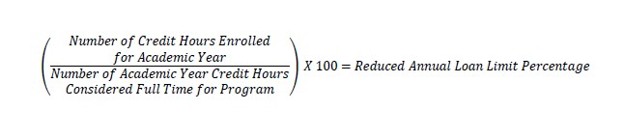
An equation that reads, Number of credit hours enrolled for academic year, divided by number of academic year credit hours considered full time for program, multiplied by 100, equals reduced annual loan limit percentage

To determine the less than full-time loan amount, multiply the full-time annual loan eligibility by the reduced annual loan limit percentage calculated in the SOR.

Example: 

A Graduate student in a Fall 2026/Spring 2027 loan period enrolled in 6 credits for Fall 2026 and had an anticipated Spring 2027 enrollment of 8 credits.

As a reminder, a Graduate student is considered full-time in Fall/Spring if enrolled in 9+ credits and can borrow up to $20,500 in a Federal Direct Unsubsidized Loan for every two-semester loan period.

Calculation:

  • 6 credits + 8 credits = 14 credits
  • 9 credits + 9 credits = 18 credits
  • 14 credits / 18 credits = 78%
  • $20,500 x 78% = $15,990

In this scenario, the Graduate student could borrow up to $15,990 in a Fall 2026/Spring 2027 Federal Direct Unsubsidized Loan.

What are the new federal loan repayment plan options?

illustration of paper money bills

Tiered Standard Plan - For loans disbursed after July 1, 2026, the repayment term is determined by the original loan balance. Payments made while enrolled in this repayment plan are ineligible for Public Service Loan Forgiveness (PSLF). 

  • Up to $24,999: 10-year repayment term (120 payments)
  • $25,000–$49,999: 15-year repayment term (180 payments)
  • $50,000–$99,999: 20-year repayment term (240 payments)
  • $100,000 or more: 25-year repayment term (300 payments)
illustration of paper money bills

Repayment Assistance Plan - RAP will replace current income-driven repayment plans (IBR, PAYE, SAVE). Eligible for PSLF.    

  • Up to 30 years to pay
  • 1-10% of Income  
  • PSLF Eligible

Overview

  • Borrowers with loans before and after July 1, 2026, will be limited to these two options for new loans.
  • RAP borrowers are not locked into a 30-year plan and can switch to a standard plan (10–25 years).
  • Borrowers with no new loans after July 1, 2026, can keep existing repayment options and may opt in to RAP.
  • All borrowers enrolled in ICR, PAYE, or SAVE must transition to a new plan by July 1, 2028—or be moved to RAP if no selection is made.

Please check back for updates as more official information becomes available from the Department of Education. Disclaimer: The information contained on this page is provided by the Mass General Brigham University Financial Aid Office as information to help students understand the changes to loans. Students should refer to studentaid.gov for official guidance.

Learn about the One Big Beautiful Bill (OBBB) Act

financial aid town hall march 2026