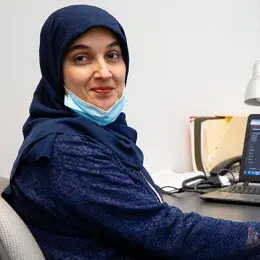
Dr. Maria Bajwa is an Associate Professor at Mass General Brigham University, where she specializes in healthcare simulation and the ethical integration of artificial intelligence (AI) in health professions education. Her work advances educator capability through technology-enhanced learning, distance simulation, and the responsible adoption of AI. Grounded in adult learning and constructivist principles, her teaching emphasizes psychological safety, critical thinking, and learner agency within simulation-based environments.
Dr. Bajwa has led influential initiatives in the field, including the development of the Distance Simulation Educator Guidelines, the Urdu translation of the Simulationist Code of Ethics to enhance global accessibility, and innovative partnership models between simulationists and AI technologists. She has also contributed foundational guidance on AI prompt design for simulation-based education. Her research focuses on faculty readiness, implementation science, and bias-aware approaches to AI integration in healthcare training.
She is a co-founder and Board Member of the AI-Simulation Healthcare Collaborative and co-founder of the AI Healthcare Simulation publication channel in the Cureus Journal of Computer Science.
At the University, Dr. Bajwa serves as Lead AI Researcher for the REBEL Lab and founded the AI Assurance Lab, which advances responsible evaluation and deployment of AI in simulation and health professions education.
- PhD in Simulation-based Education, MGH Institute of Health Professions, Boston, MA, USA
- MSMS in Medical and Healthcare Simulation, Drexel University, College of Medicine, Philadelphia, PA, USA
- AAS, in Health Information Technology, SUNY Broome Community College, Binghamton, NY, USA
- MBBS (Medical Doctor), Abbottabad, KPK, Pakistan
- Healthcare simulation
- Artificial Intelligence in healthcare education and simulation
- Distance and virtual simulation
- Professional development
- Interprofessional education
Dr. Bajwa has published numerous papers - some titles are highlighted below.
Development of Distance Simulation Educator Guidelines in Healthcare.
Technological Competence of Distance Simulation Educators.
AI Simulation Partnership Framework.
A guide to prompt design: Foundations and applications for healthcare simulationists.