

The Elephant in the Room, Part 1: AI’s Environmental Footprint


The elephant in the room
Back from HLTH
I just got back from HLTH in Las Vegas. For colleagues in health professions education who may not know it, HLTH is one of the largest healthcare innovation conferences in the country. It brings together more than 12,000 health system leaders, startups, investors, payers, and clinicians for four days of talks, product demonstrations, and back-to-back meetings with companies (HLTH). It is less an academic conference than a marketplace, and it is a good place to see where healthcare technology is heading before it reaches our classrooms and clinics.
This year, AI was on nearly every stage. I spent my days with companies working on discharge education, voice-based patient outreach, care navigation, food as medicine, and readmission prediction.
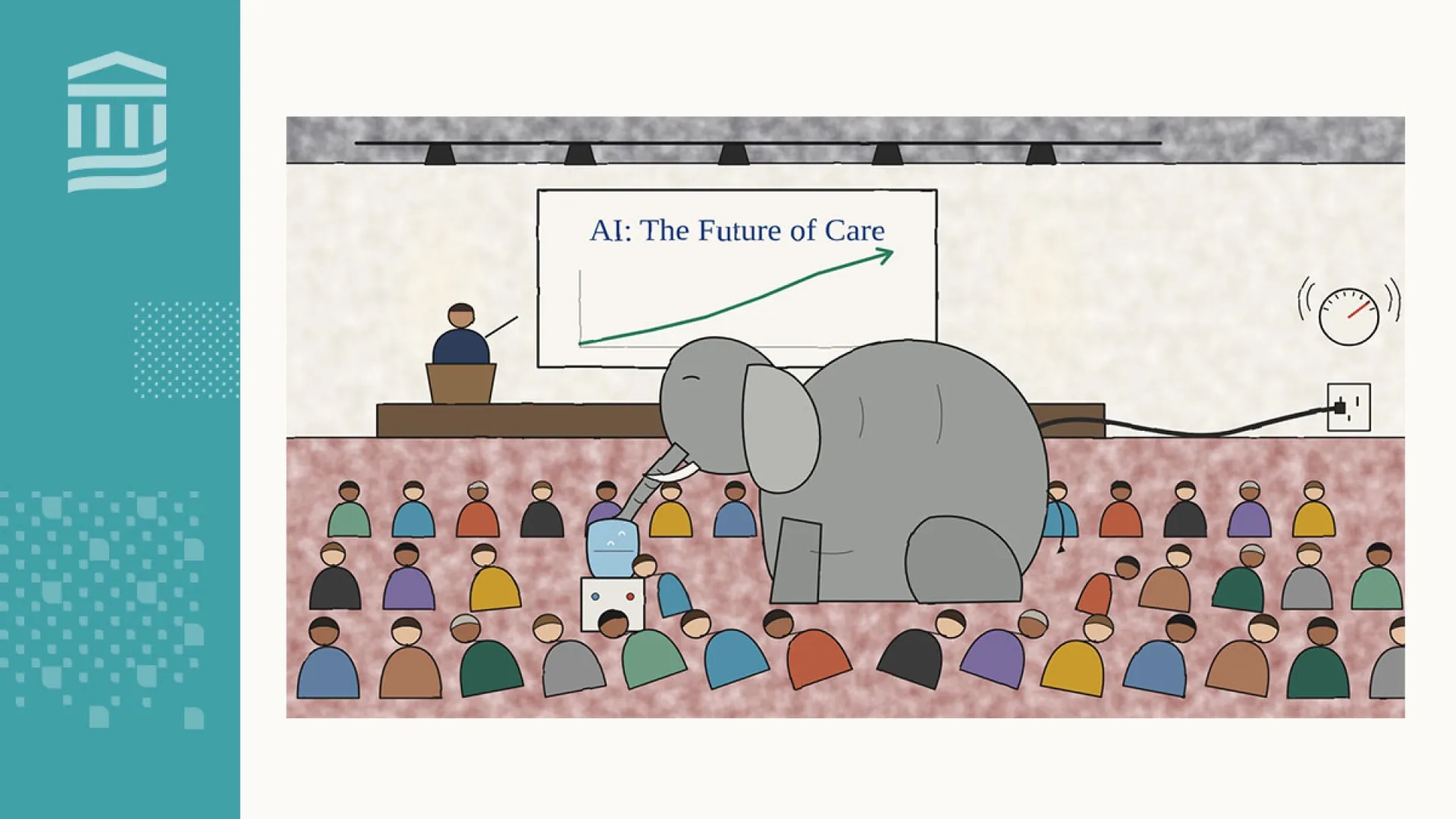
But there was an elephant in the room: the environmental cost of the AI we were all there to discuss. I did not attend every session, and it may well have come up in conversations I missed. But I did not hear it raised in the sessions I attended. Afterward, I read through the session descriptions on the agenda. More than half mentioned AI, and none that I could find listed climate, emissions, data centers, electricity, or water as a topic (HLTH agenda). That struck me, because electricity prices and data centers became a major issue in this year’s midterm elections, after flying under the radar in past national races. The topic is front and center for voters, yet largely absent from the technology conversations I have been part of.
I will admit this was not part of my own lens until recently. It surfaced during a conversation on our Mass General Brigham podcast, where we were looking at AI in health professions education through a critical lens and a systems approach. Once it came up, I could not stop seeing it.
The value is real
I’ll start with this: I believe AI has profound value in healthcare. I have seen it in my own work. On our transitions-of-care team, I used to review less than 1% of our telehealth calls, usually months after they happened. An AI coach now gives content feedback on every call, in close to real time. AI patient simulation has also become part of onboarding for our department, giving new team members a safe place to practice before their first real patient conversation, and it has measurably improved how our team communicates on real calls (Simulation in Healthcare; Simulation in Healthcare).
In population health, AI can add visibility where there has been none. It can surface the patient who is quietly getting worse at home, the gap in follow-up, or the pattern across thousands of discharges that no one person could see. That visibility is worth a great deal. But visibility has a cost, and part of that cost is paid outside the hospital walls.
The undercurrent: power, water, and the cost of living
A single AI request uses very little energy. Google’s own measurement puts a typical text prompt to its Gemini chatbot, not counting model training or image and video generation, at less than nine seconds of television (Google), though that is a company reporting on its own product. The issue is scale. Billions of requests a day, served from ever-larger data centers, add up quickly. The International Energy Agency projects that electricity used by data centers worldwide will more than double by 2030, with AI as the main driver, and that data centers will account for almost half of US electricity demand growth over that period (IEA). The same report notes real uncertainty in these projections, and finds that the added emissions are small relative to the energy sector as a whole and could be offset if AI helps cut emissions elsewhere.
Water is the less visible part of the story. A Department of Energy report from Lawrence Berkeley National Laboratory estimated that US data centers used many times more water indirectly, through the power plants that supplied their electricity, than they used directly for cooling, an estimate based on the regional grid mix (Berkeley Lab).
Then there is the cost to households. Electricity prices are rising (EIA), but how much of that comes from data centers is genuinely debated. A Columbia University review, funded by Google.org, found the main drivers so far have been grid upgrades, fuel costs, storms, and policy. Going forward, it warns that data center costs could shift onto households unless regulators make data centers pay for the grid upgrades they require (Columbia Center on Global Energy Policy).
Healthcare has a particular stake here. Our sector already produces about 8.5% of the country’s greenhouse gas emissions, by a 2018 estimate. Electricity is the largest single source of those emissions, and the authors estimate the resulting harm to public health is on the same scale as harm from preventable medical errors (Health Affairs). Any rise in utility bills also falls hardest on the very patients we are trying to keep healthy at home.
The rural paradox
Rural America is where the next wave of data centers is being built, and also where AI’s benefits are hardest to reach. Most existing data centers sit in cities, but about two-thirds of those now in development are planned for rural areas, and about 4 in 10 are in counties that have none today (Pew Research Center).
At HLTH, I spent time with people from a coalition focused on rural health. Their priority was not a new algorithm. It was Medicaid parity and fair reimbursement for the virtual care they already provide, including neurology and other specialties. I also met a physician running a small practice in a rural California town who simply wanted practical tools to help patients get care.
Put together, the picture is uncomfortable. Rural communities may host the power plants, transmission lines, and water use that AI depends on, while waiting the longest to see its benefits in their own clinics. Responsible use has to account for both sides of that ledger.
Who uses AI, and who pays for it
The same pattern shows up globally, and more sharply. Microsoft’s usage data, again a company source, finds that about 29% of working-age people in the Global North use generative AI, compared with 16% in the Global South, and the gap is widening rather than closing. Microsoft also found that where AI is used in the Global South, a larger share of that use goes to education and learning (Microsoft). Infrastructure tells a similar story. The World Bank reports that Africa has 18 percent of the world’s population but just 0.6 percent of global data center capacity, the computing power that runs AI (World Bank). The World Bank likewise finds that AI use in Sub-Saharan Africa centers on learning, yet only about 2 percent of AI training data comes from Africa (World Bank).
The climate costs run the other way. A Lancet Countdown paper on Africa describes the substantial damage climate change is already doing to the continent, with direct links to infectious disease, malnutrition, and food insecurity (The Lancet). In many places, the people using AI the least are absorbing more than their share of the consequences. That makes this a health equity question, not only a technology one.
Coming in Part 2
The environmental cost is only one part of a larger animal. In Part 2, I turn to the old parable of the blind men and the elephant, what W. Edwards Deming taught about systems, and what all of this means for how we teach AI in the health professions.
This post was inspired by a conversation with Dr. B.A. White, Distinguished Teaching Professor of Health Professions Education at Mass General Brigham University of Health Professions, which broadened my view of what the conversation about AI should include. Dr. White and I co-host AI and the Future of Learning, a new series on the Mass General Brigham Health Professions Education podcast launching in January 2027 at mgbuhped.transistor.fm.
A note on my own use: I am an active user of AI in my clinical work, my teaching, and my data analysis, and I used it here to help generate the image and edit my writing. Writing this post has given me some pause about that use, too.
Farrukh N. Jafri, MD, PhD, is a term lecturer at Mass General Brigham University of Health Professions and an associate professor of emergency medicine at Albert Einstein College of Medicine.
Sources
- HLTH USA frequently asked questions (HLTH)
- HLTH USA agenda at a glance (HLTH)
- Jafri FN, et al. Artificial intelligence-powered simulation for telehealth communication training: bridging traditional simulation and artificial intelligence. Simulation in Healthcare, 2026
- Jafri FN, et al. Implementation of artificial intelligence-powered patient simulation for communication training in a telehealth transitional care program. Simulation in Healthcare, 2026
- Measuring the environmental impact of delivering AI at Google scale (Google, company self-report)
- AI is set to drive surging electricity demand from data centres (International Energy Agency)
- 2024 United States Data Center Energy Usage Report (Lawrence Berkeley National Laboratory, US Department of Energy)
- Short-Term Energy Outlook: Electricity (US Energy Information Administration)
- The effects of load growth on electricity prices in the United States: a literature review (Columbia University Center on Global Energy Policy)
- Eckelman MJ, et al. Health care pollution and public health damage in the United States: an update. Health Affairs, 2020
- Most new data centers in the U.S. are coming to rural areas (Pew Research Center)
- The continued state of global AI diffusion in 2026 (Microsoft, company data)
- Building AI Readiness: Africa Economic Update, October 2026 (World Bank)
- Ali Z, Abubakar I, et al. Lancet Countdown on health and climate change in Africa: an international collaboration for locally led research and action. The Lancet, 2025