


Looking Beyond the Diagnosis
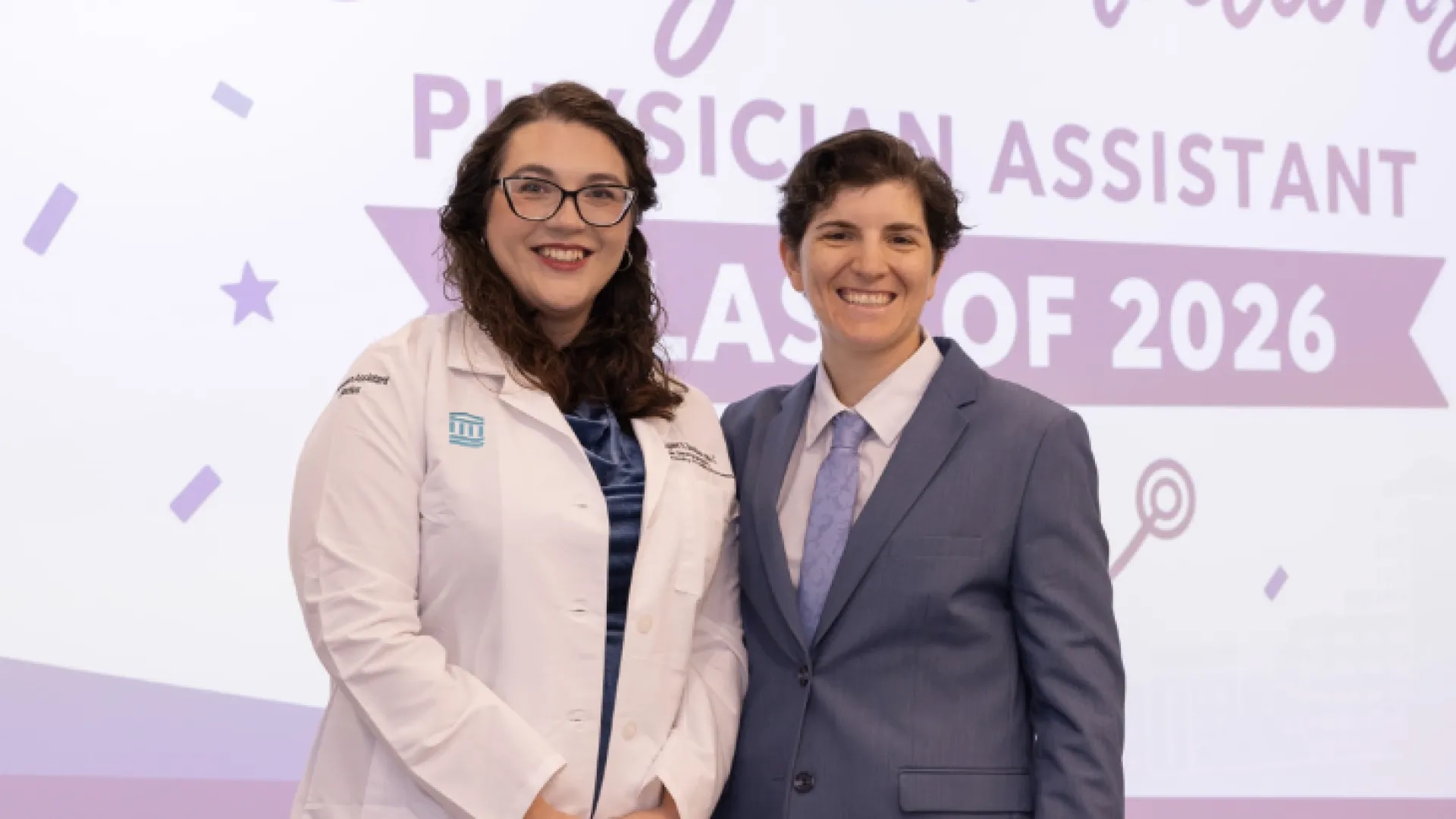


Physician Assistant Studies Student Margaret Bouchard's First Clinical Rotation Leads to Published Research and a Broader Understanding of Patient Care
Margaret Bouchard’s decision to pursue physician assistant studies at Mass General Brigham University of Health Professions grew out of her years of experience working directly with patients.
“I had been a medical assistant for almost 10 years, and I decided I wanted to be more involved in patient care,” Bouchard said. “I really appreciated the collaborative nature of the physician assistant career.”
During her first clinical rotation at Mass General Brigham Cancer Institute, Bouchard encountered an unusual patient case that would eventually become the subject of a published research paper.
“It was sort of sheer luck that I happened to be on her care team,” Bouchard recalled. “She had a very unique presentation, and trying to figure out what exactly was going on with her had proven to be a challenge while she was inpatient.”
The patient had developed severe hemolytic anemia and liver injury after taking acetaminophen. Initial testing did not explain her condition, prompting the medical team to investigate further. Genetic testing eventually revealed a previously unreported mutation affecting glutathione reductase (GSR), an enzyme that helps protect cells from oxidative damage.
The case became the basis of Bouchard's capstone project and a separate research paper, published in Blood Red Cells & Iron in 2026.
“My capstone project was slightly different from the published article,” Bouchard explained. “My capstone project focused more on the importance of considering broader testing options when you're encountering a challenging diagnosis, and the importance of thinking outside the box.”
The published study was a collaboration with her preceptor Jennifer Mead and physicians John Schell, Rachel Rosovsky, and David B. Sykes. Bouchard helped draft the manuscript, participated in a patient interview, and briefly assisted with molecular diagnostic work. She continued following the patient's recovery even after her rotation ended.
For Bouchard, working alongside experienced clinicians was as valuable as contributing to the publication. The rotation gave her a chance to learn from specialists while taking part in the care of patients whose conditions were far beyond what she could manage independently.
“I was very lucky to work with providers who are the best in their field,” Bouchard said. “I think showing up every day and being willing to see these challenging patients that you are definitely not going to be able to manage on your own, but being willing to get your hands dirty and ask questions and really think about what's going on, is really important to the learning process.”
The rotation also brought her classroom training to life. Bouchard recalled examining the patient's blood smears and watching her red blood cells gradually improve throughout her recovery.
“It was a great opportunity to connect a lot of the concepts that we learned in the classroom about hematology and see it play out in real life,” she said. “Being able to see this patient's peripheral smears, at the beginning they looked terrible, and then gradually they improved. Seeing that progression from unhealthy blood cells to healthier blood cells really helped highlight how much damage can be done with an undiagnosed hemolytic anemia.”
Working closely with physicians also gave Bouchard a clearer sense of the PA's role in patient care. She saw how PAs brought their observations to the medical team, helped evaluate patients, and worked with attending physicians to make clinical decisions.
“We worked hand in hand with the attendings, bouncing ideas off of them and getting feedback from them,” Bouchard said. “But we were usually the first people to see these patients.”
The experience sparked an interest in hematology and the problem-solving side of medicine. Bouchard found herself drawn to the challenge of working through a patient's symptoms and finding an explanation for an unusual condition.
“It's definitely cultivated a love of hematology, but also the more intellectual side of medicine,” Bouchard said.
That curiosity also shapes Bouchard's advice to PA students interested in research. She recommends attending specialty rounds, where clinicians discuss unusual cases, as a way to learn from experienced providers and explore opportunities to get involved.
“Always be willing to ask questions,” she said, adding that participating in those discussions can be an important step toward “getting your foot in the door for research.”
But when Bouchard reflected on what she had learned, one lesson stood out beyond the research and publication.
“One of the most important things that I took away from this case has very little to do with my project or the case study,” Bouchard said. “At the end of the day, this patient's diagnosis didn't really change how we treated her. But it gave her the knowledge of what was going on, and I think that was more important to her than the recovery itself.”
For Bouchard, that understanding is something clinicians should carry into every patient interaction.
“Educating them and empowering them with the knowledge of a diagnosis.”