

Helping Runners Stay on the Road
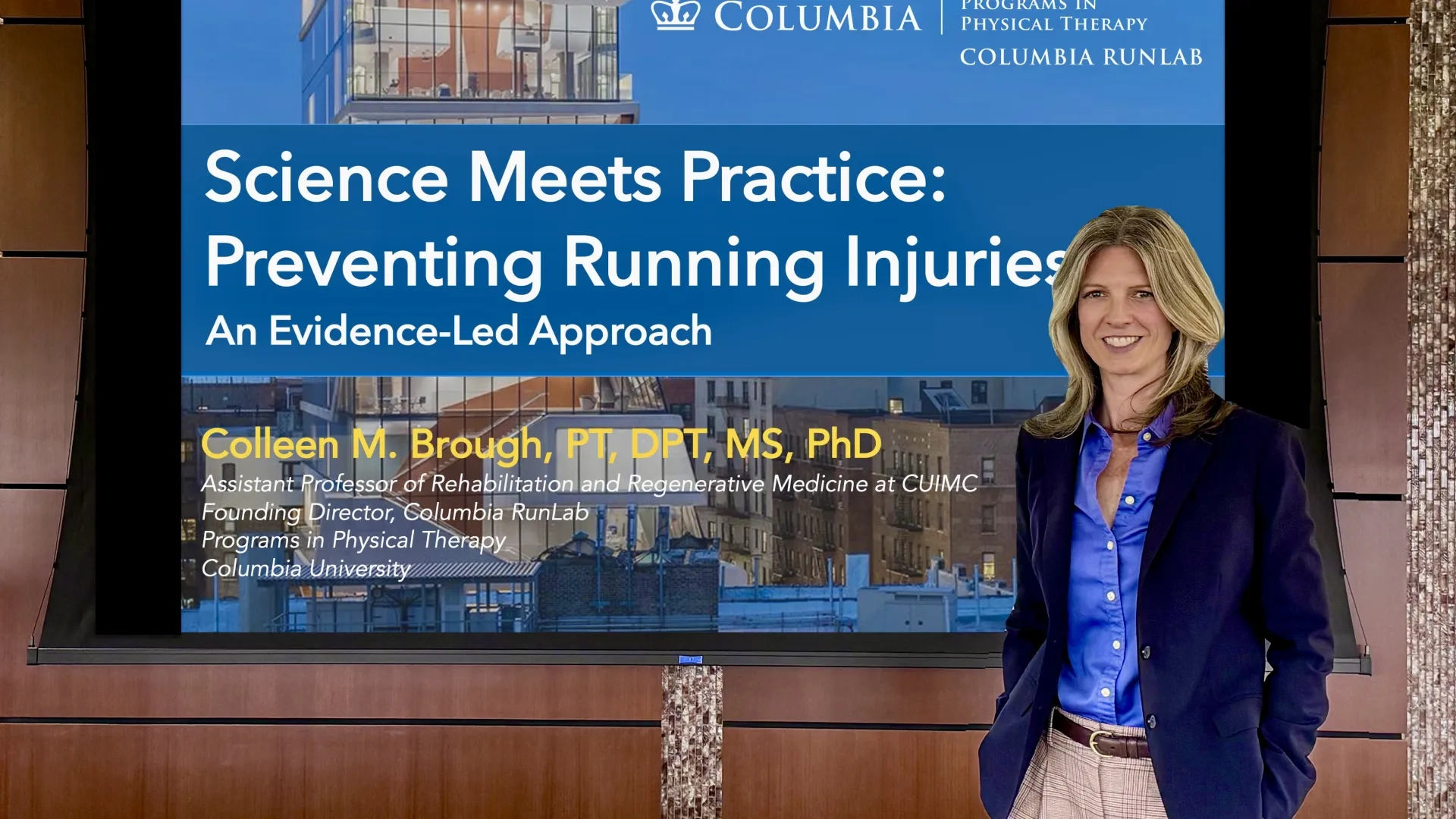


2014 DPT graduate takes holistic approach at Columbia University’s RunLab
For Dr. Colleen Brough, getting runners across the finish line is a lot more than just focusing on their injury.
Take a hamstring tweak. While one could treat that issue separately, the 2014 graduate of the Mass General Brigham University’s Doctor of Physical Therapy program takes a more holistic approach she’s developed from years of working in orthopedics and early on with patients with spinal cord injuries and those recovering from stroke.
“I can't tell you how many of these runners had no changes in their training but had some significant life event. And not unexpectedly, that happened to coincide with their high hamstring strain that they just can't get rid of,” said Brough. “Over my career my view has evolved, and I’ve come to really appreciate biopsychosocial influences, and to also start to better appreciate that I don't have all the answers. I consider more and more of the possibilities that we can influence to try to help this runner stay on the road.
“That is a very different type of thinking than the typical linear thinking that you often see in orthopedics.”
Brough, a life-long athlete who runs half marathons, is the founding director of RunLab at Columbia University in New York City, which she began in 2016.
Students she oversees at Columbia RunLab treat runners who range from weekend warriors to Olympic hopefuls. From the start, the lab has collected data from every patient which she will use as part of future grant proposals.
Brough, who earned her master’s in physical therapy in 2000, discovered a love for teaching while working with students in the clinic and as a guest lecturer at Columbia. She chose Mass General Brigham University’s doctoral program because of its focus on teaching and research and its ranking as one of the top programs in the country, according to U.S. News & World Report.
She focused on the shoulder for her end-of-program capstone project, which she described as a springboard to developing classroom curricula.
“It was a framework for using evidence-based practice methods,” she said. “I had always valued that, but that this really made me sit with research in a way that was new and uncomfortable. It really made me grow as a clinician, and that improved my teaching.”
Recently, she completed a PhD from Indiana Institute of Technology where she leaned into educational leadership. Her dissertation focused on anti-racist pedagogy - how to teach and create environments that recognize and address systemic racism in healthcare.
“Healthcare providers can be complicit in perpetuating racism,” Brough said, noting how people’s treatment based on racial bias continue, an approach that often ignores the wide array of social determinants that can affect a person’s health. “So, when I teach, I’m intentional about representing the diverse population that physical therapists treat without reinforcing the various stereotypes we're trying to get rid of. If we get into this profession to help people, then we better be in it to help all people.”