


Getting to the Heart of the Cardiac Implantable Electronic Device Management Program


Interview with Program Director Shweta Gore
Mass General Brigham University recently launched a Cardiac Implantable Electronic Device Management program to help meet the need for trained technicians. Shweta Gore, program’s director, spoke to Lisa McEvoy about the need for this program, what it entails, the various careers available upon completion, and the background of people who are interested in the program.
Why did the University start this program?
Shweta Gore: The program emerged from a workforce need identified in collaboration with the Mass General Brigham Heart and Vascular Institute. Cardiac device clinics need skilled technicians, but there are relatively few formal academic pathways specifically designed to prepare people for these positions.
Historically, individuals could enter the field with limited device-specific preparation and then require extensive on-the-job training, sometimes approaching a year, before they could function more independently. At the same time, advances in cardiac implantable devices have made the work increasingly sophisticated.
In collaboration with the Heart and Vascular Institute, the University recognized an opportunity to develop professionals through a structured educational pathway rather than relying almost entirely on prolonged workplace training. We were well positioned to respond because of our expertise in healthcare education, simulation, interprofessional learning, and clinical partnerships.
Can you explain how the program is designed?
SG: The program combines academic preparation, hands-on simulation, supervised clinical experience, research exposure, and career preparation.
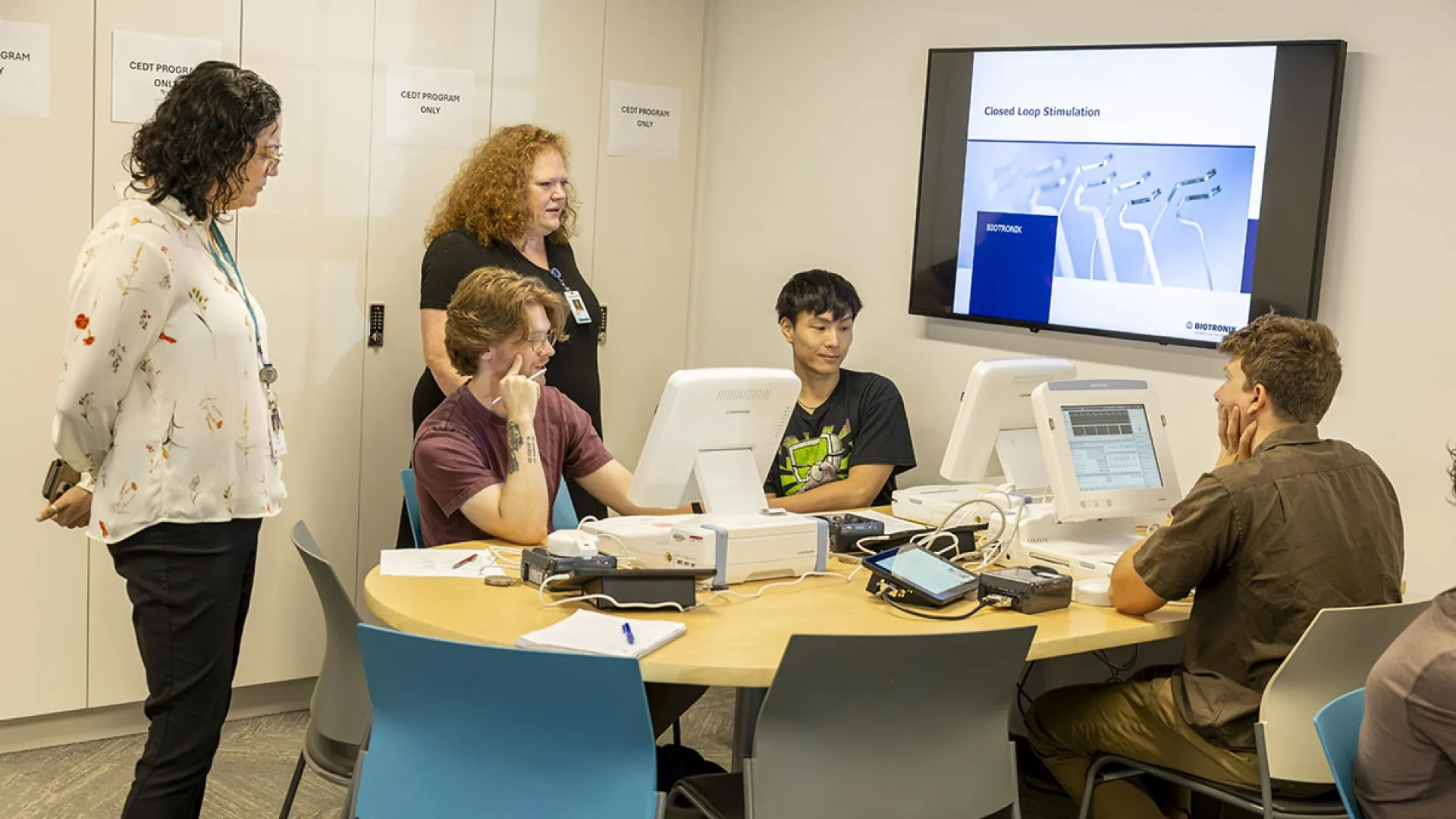
It is a two-semester program. The beginning of the program is all remote. Students start with didactic work to build foundations in cardiovascular anatomy, physiology, and ECG. Once they have that knowledge, they come on campus for simulation labs. Students participate in onsite simulation and programming laboratories, including opportunities to work with device-programming simulators. In the second semester, students are fully embedded in a clinical setting. There is also a research course where students are introduced to research and evidence-based practice and are supported in developing work that they can present to peers, faculty, clinical partners, and industry representatives. This helps them develop communication, critical-thinking, and professional leadership skills.
What happens in the simulation labs?
SG: Students work with simulator programmers in the simulation lab under the guidance of skilled device technicians from MGH to identify and program rhythms and program cardiac devices (e.g., pacemakers, ICDs, etc.).
They also have an ECG simulation lab where they are in simulated hospital rooms. They interact with patient actors and work to identify different ECG rhythms on the patient monitor, which then helps them to figure out what they would do in that moment with a real patient.
What are the clinical experiences like for the students?
SG: We are fortunate to have experts who can work with students. The program was developed in collaboration with the Mass General Brigham Heart and Vascular Institute, one of the world’s most renowned centers for heart and vascular care, and our director of clinical education is Jay Cullivan, the Institute’s lead cardiac device nurse.
Students work with patients and their clinical preceptors two full days a week for the entire semester. This can be in an inpatient setting where patients have just had surgery to implant a pacemaker, and they are working with the surgical team to ensure the programming of the device is all set. They can also work in an outpatient clinic where patients come from regular checkups to make sure the rhythm the pacemaker is set to is fine or in electrophysiology labs. They may also work in settings where they remotely monitor the rhythm.
What are some of the reasons students are interested in the program?
SG: Most have had at least some contact with healthcare in some way, shape, or form. They have worked as medical assistants, EMTs, and patient care associates. Some have come from healthcare management or an administrative background and are looking for hands-on work. Others see it as a step in preparation for a different degree program. So they may want to join a physician assistant studies program or become a nurse but aren’t ready to do that yet. This is a good step because they gain academic credit. We also get nurses who’ve worked in the field for a long time and want to go into the cardiac device world. A completely different group of people have engineering or bioengineering backgrounds, and they are interested in the technology side and device programming with an eye to working for a cardiac device company or going into bioengineering research in the field.