


Fewer Falls for Stroke Survivors is Goal of New Interprofessional Research Grant
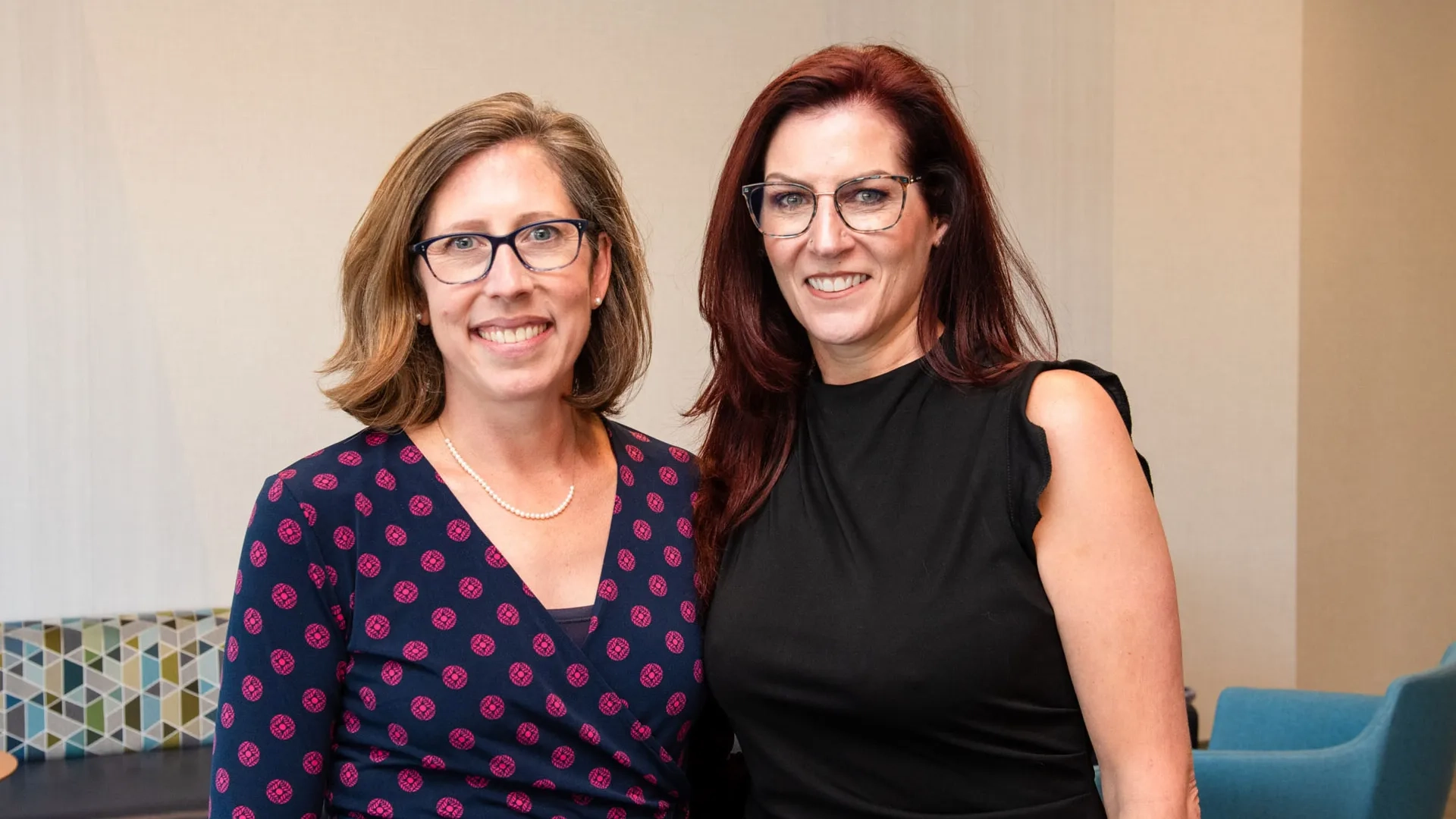


Plummer, Schliep utilizing nearly $4 million NIH grant to study issue
Two Mass General Brigham University of Health Professions faculty are taking an interprofessional approach to develop strategies that will decrease the propensity of stroke survivors who fall after leaving the hospital.
Dr. Prue Plummer, a physical therapist, and Dr. Megan Schliep, a speech-language pathologist, recently were awarded a five-year, $3.8 million R01 grant from the National Institutes of Health. “Fall Phenotyping after Stroke to Improve Prediction and Prevention of Falls” will study for the first time integrating motor-focused physical therapy evaluation with cognitive and communication assessments. The study’s goals are to validate a novel and concise fall-risk screening tool, identify distinct clusters of post-stroke fall types, determine a set of predictors associated with each type of fall, and evaluate reasons why some stroke survivors don’t fall.
The overarching goal: to develop more effective fall-prevention training and strategies for clinicians to use before a patient returns home.
“Traditionally, most measures have been very focused on physical mobility and balance domains so our work is really trying to understand how taking an interdisciplinary approach by adding communication factors may impact someone's recovery,” said Schliep, an assistant professor of communication sciences and disorders. “That’s what makes it unique.”
Plummer and Schliep note that current rehabilitation practices are failing to prevent falls, leading to an exceptionally high rate of falls for stroke survivors during the first six months after discharge home from the hospital – as high as 73 percent, according to a 2025 study. Inaccurate pre-discharge assessments, they say, can impede identifying people who are more likely to experience a fall as well as hinder providing strategies for them to avoid falling.
“To be able to test our hypotheses, we need to have a good representation of motor abilities and linguistic abilities so that we can develop clusters for symptom profiles,” said Plummer, a professor of physical therapy who runs the school’s Cognitive-Motor Behavior Lab. “It will provide a more robust way to be able to say that different sets of risk factors belong to specific clusters of fall types.”
The team will recruit 402 participants and provide them with Apple watches, a method they devised after consulting with Dr. Elizabeth Goldberg, a professor of emergency medicine at the University of Colorado Anschutz School of Medicine, a fall-prevention specialist who focuses on using wearables. A custom app will allow Plummer and Schliep to track and code each fall event as it occurs during the first three months after a survivor is discharged from inpatient rehabilitation.
Working with Dr. Annie Fox, an associate professor of healthcare data analytics at the school, they will use statistical modeling to determine fall clusters and create predictive models that may aid clinical decision-making before discharging patients.
All participants will be recruited at Spaulding Rehabilitation Hospital, a fellow Mass General Brigham affiliate located a short distance away in the Charlestown Navy Yard from the university’s campus.
Dr. Qing-Mei Wang, a physiatrist at Spaulding who is working with Plummer and Schliep, anticipates the study will have a number of positives such as equipping clinicians with more detailed data so that they can tailor interventions for patients to avoid falls after discharge and thus decrease return visits, and strengthen research cooperation between the university and the hospital.
“Such collaboration not only enhances the scientific rigor and impact of the study but also establishes a sustainable model for future joint initiatives aimed at advancing precision rehabilitation and improving patient-centered outcomes,” Wang said.
Plummer and Schliep began working together in 2020. Schliep had just completed the university’s PhD in Rehabilitation Sciences program and wanted to continue on campus as a post-doc investigator. Plummer had just started the lab after arriving at the school the year before. Dr. Nara Gavini, the associate provost for research, saw that their research interests were similar and suggested they would make a good mentor-mentee pair.
In 2023, Schliep received a $15,000 seed grant from the university’s Tedy’s Team Center of Excellence in Stroke Recovery, which was funded and created by Tedy Bruschi and his wife Heidi after the former New England Patriot great had several strokes. The Mobility and Cognitive-Communication Recovery after Stroke (MOCO) study found, for example, that stroke survivors with a high risk of falls who have a communication impairment tend not to fall as much. This led Schliep and Plummer to hypothesize it is because someone is more frequently assisting them. That study’s results spurred the researchers to continue honing their work, leading to being awarded the NIH grant, which also will fund two new PhD in Rehabilitation students and one postdoctoral scholar.
“This is an example of exactly what the university is trying to develop, where Megan and I began as mentor-mentee and it’s grown into a peer-collaborator relationship where we jointly mentor the trainees in the lab as well as each other,” said Plummer. “The lab is truly doing interdisciplinary work because we were approaching the same kinds of questions but with different clinical experiences and perspectives. I'm really proud of what we've been able to do.”