


Class of 2029 Welcomed into Occupational Therapy Profession at Commitment Ceremony
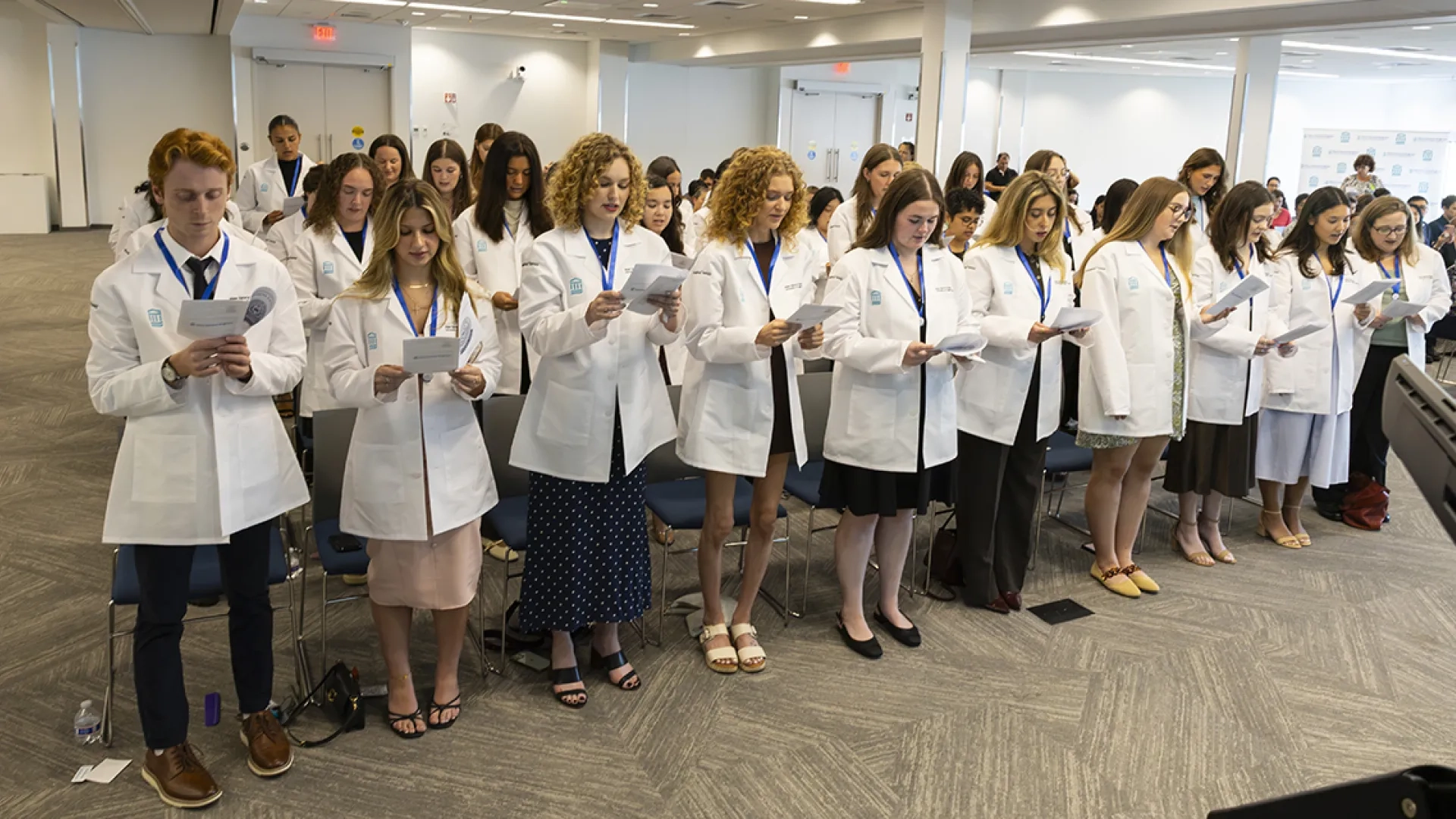


Surrounded by family, friends, faculty, staff, and members of the occupational therapy community, the Entry-Level Doctor of Occupational Therapy Class of 2029 marked an important milestone in their professional education as they donned their white coats, received their University pins, and recited the Pledge of Professionalism at the annual OT Commitment Ceremony. The ceremony, which took place last Friday in 1CW, serves as a rite of passage for students entering the occupational therapy community of practice. This year’s 37 students join more than 320 alumni who have participated in the tradition before them.
For Sarah McKinnon, Chair of the Department of Occupational Therapy, the ceremony represents not only the students’ entry into the profession, but their place within a much larger community committed to their development.
“Today, you are part of a community that will teach you, challenge you, mentor you, and ultimately help shape the occupational therapist you will become,” McKinnon told the students. “We’re ready for you to be the best-trained OTs in the country.”
Entering a Community of Practice
Emily Eddy, Program Director of the Entry-Level OTD program, welcomed the students into what she described as a community united by a shared commitment to learning, reflection, and occupational therapy practice. She reminded students that becoming an occupational therapist involves developing not only scientific and clinical competency, but also the ability to connect with people and understand what is meaningful in their lives.
“Your future patients and clients will rely on you for competence in delivering science-based interventions, while supporting them in returning to what is meaningful to them through the authentic and learned art of reaching out to them with comforting touch and heart-filled care,” she said.
A Patient’s Perspective on the Power of OT
That message took on special meaning through keynote speaker Hannah Strom, a brain injury survivor who now works as a rehabilitation aide at Spaulding Rehabilitation Hospital in the Charlestown Navy Yard. Strom sustained a severe traumatic brain injury in 2020 after having been a collegiate rower at the College of the Holy Cross. During her remarks, she described how suddenly losing independence changed her understanding of everyday activities, and how occupational therapy helped her redefine what independence could look like.
“OT helped me realize that independence does not have to look exactly the same as it used to,” Strom shared. “Recovery teaches you that independence can also mean adapting, problem-solving, learning new strategies, and giving yourself grace on the days when things are harder.”
She also offered the future occupational therapists a message she hoped they would carry into their own practice: the seemingly small interactions with patients can have a lasting impact. More than six years after her injury, Strom lives independently in Charlestown and now supports patients and families on the comprehensive rehabilitation floor at Spaulding. Her experience, she said, has given her a unique perspective on rehabilitation and the importance of hope, empathy, and perseverance.
A Commitment to Participation, Belonging, and Service
At the heart of the ceremony was a commitment to one of occupational therapy’s central principles: every person has the right to participate in a life that is meaningful to them.
After receiving their pins, the Class of 2029 joined occupational therapy practitioners and students in attendance to recite the Pledge of Professionalism, publicly committing themselves to compassionate and ethical care, evidence-based practice, lifelong learning, interprofessional collaboration, advocacy, and service.
For the newest members of that community, the white coat and pin represent the beginning of a journey that will unfold across classrooms, clinical settings, communities, and eventually their own professional practice, with a reminder from Strom that may stay with them long after the ceremony.
“You are not only helping people improve physically. You are helping people reconnect with themselves," she noted. "You are helping someone believe they still have a future. You are helping someone regain confidence. You are helping someone feel human again during some of the hardest moments of their lives.”