

Advancing Health Equity Through Research, Mentorship, and Inclusive Leadership
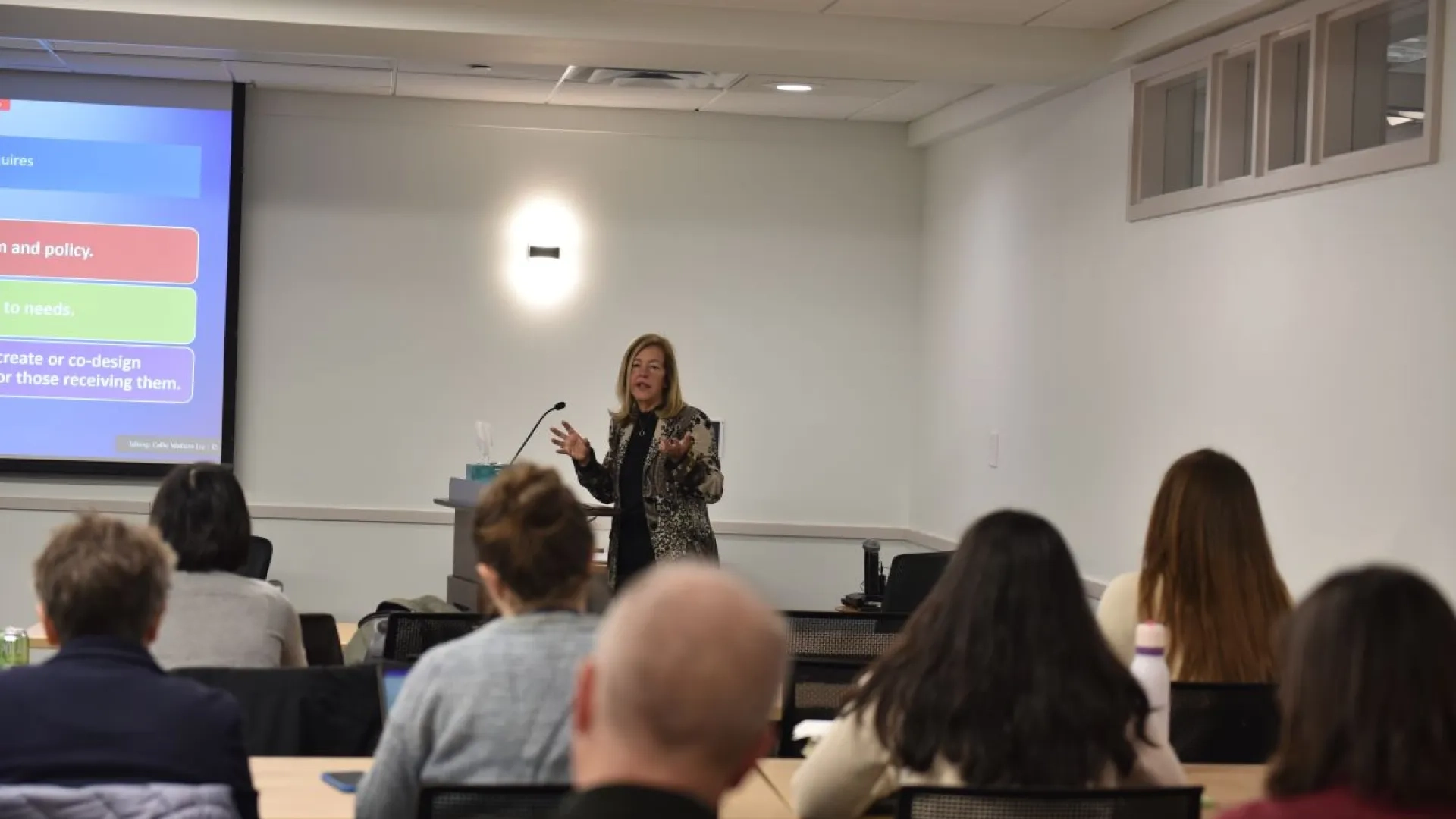


Margarita Alegría, PhD, has spent her career developing methods that reduce health disparities for minoritized populations, immigrants, and linguistic minorities. During the E. Lorraine Baugh Visiting Faculty Lecture earlier this month, the chief of the Disparities Research Unit at Massachusetts General Hospital and the Mongan Institute shared her thoughts and work related to several topics, including disparity in quality of care by race and ethnicity, the impact of a diverse healthcare workforce, and the effects of discrimination.
A common thread across the research she cited was importance of context, both in how an individual reacts to that context and the social context that is contributing to health disparities.
“If you really want to have a big impact, [we need to move away] from individual interventions to more structural interventions that change the social, physical, economic, or political environments that may shape or constrain health and behavioral outcomes,” Alegría said to those gathered in Building 39. “How do you alter that larger social context by which health disparities emerge and persist?”
She spoke about research that showed that racial concordance between patients and providers is associated with better health outcomes and that a racially diverse hospital staff is tied to better patient outcomes as well as better workplace efficiency.
“We find that in a lot of the studies that we do, we look at the provider and the patient and see that racial ethnic concordance is quite important,” said Alegría. “It's actually tied to life expectancy and mortality rates.
“The other thing we know is underrepresented minority health trainees are more likely than non-URMs to go back and serve underserved populations.”
Established in 2012, the visiting faculty speaker series emphasizes health equity and inclusion in the health professions and honors E. Lorraine Baugh, a long-serving trustee and first chair of the Institute’s Board of Trustees who is now an Honorary Trustee who attended the lecture virtually. Hosted by the Office of Mission, Values, and Community Excellence, the event is made possible by the support of Mass General Brigham University Honorary Trustee Carol M. Taylor and her husband, John H. Deknatel.
“Dr. Alegria has conducted impactful research that has implications for how we can engage in health equity,” said Chief Health Equity and Community Excellence Officer Kim Truong, adding that she is a good resource for those interested in conducting similar research.
“She has a wealth of knowledge about mentorship and applying for research grants that members of our community can learn from.”